
Enfermedad ateroesclerótica difusa: un reto en el manejo de la hipertensión renovascular.
Reporte de caso.
DOI:
https://doi.org/10.56867/Palabras clave:
Enfermedad ateroesclerótica difusa, Hipertensión renovascular, Reporte de casoResumen
Introducción: Las enfermedades crónicas no transmisibles representan la principal causa de morbilidad en el Ecuador; el 20% de los adultos tienen hipertensión arterial. En adultos mayores, la enfermedad renovascular ateroesclerótica representa hasta el 35% de las causas de hipertensión secundaria, lo que incrementa el riesgo cardiovascular.
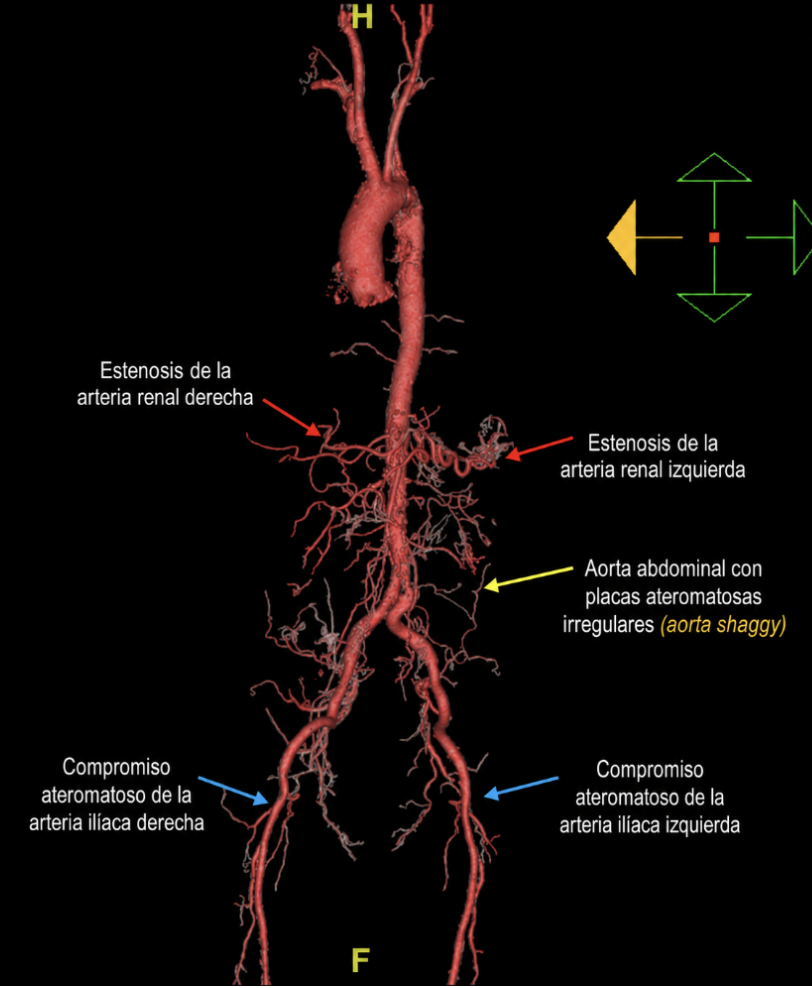
Reporte de caso: Varón de 82 años con antecedentes de hipertensión arterial desde los 77 años (tratamiento: valsartán/amlodipina). Consultó por debilidad del miembro inferior derecho de 45 días de evolución. Ingresó con una presión arterial de 160/98 mmHg. La resonancia cerebral evidenció lesiones isquémicas subagudas y hemorrágicas previas. La angiotomografía mostró aorta Shaggy, estenosis severa (carótida interna derecha y arterias renales) (Figura 1, Tabla 1), creatinina 1,85 mg/dL, TFGe 35 mL/min/1,73 m² y RAC 445,4 mg/g, compatible con enfermedad renal crónica secundaria a nefroangioesclerosis hipertensiva. Por deterioro de la función renal (creatinina 2,3 mg/dL; TFGe 27 mL/min/1,73 m²). Se suspendió ARA II e inició tratamiento con calcioantagonistas y betabloqueantes, logrando una recuperación parcial de la función renal (creatinina 1,6 ; TFGe 42). Se descartó la revascularización por alto riesgo embólico y se indicó tratamiento médico. Dos meses después, reingresó por infarto medular trombogénico (C7-T1), hipertensión arterial y ajuste del tratamiento antitrombótico.
Resultados: La estenosis de la arteria renal > 50% produce repercusión hemodinámica y > 70% hipertensión renovascular. La aorta Shaggy se asocia con alto riesgo de embolización sistémica, mientras el tratamiento médico tiene mayor beneficio que el intervencionismo. El uso de IECA o ARA II en presencia de estenosis bilateral de las arterias renales favorece el deterioro de la función renal.
Conclusión: La ateromatosis aórtica difusa incrementa 4,1 veces la morbilidad y mortalidad, favorece eventos tromboembólicos. La endarterectomía no se recomienda debido al elevado riesgo de accidente cerebrovascular; el manejo médico individualizado es la mejor alternativa, especialmente cuando coexiste con hipertensión renovascular.
Descargas
Publicado
Número
Sección
Licencia
Derechos de autor 2026 Kateherine Fonte Melendres, Fernando Jiménez Jaramillo. (Author)

Esta obra está bajo una licencia internacional Creative Commons Atribución-NoComercial-CompartirIgual 4.0.
 10.56867