
Retrospective observational study of percutaneous peritoneal dialysis catheter placement using the Veress needle versus the conventional percutaneous technique.
DOI:
https://doi.org/10.56867/Keywords:
Percutaneous peritoneal dialysis catheter placement, Veress needle, Conventional percutaneous techniqueAbstract
Introduction: Percutaneous placement of a peritoneal dialysis catheter is a minimally invasive alternative for peritoneal access. Initial entry into the peritoneal cavity is the highest-risk step due to the potential for injury to intra-abdominal organs. To improve procedure safety, a modified technique using a Veress needle for initial access was implemented. The study aimed to compare the feasibility, technical success, and complication rates of percutaneous peritoneal dialysis catheter placement using the Veress needle technique versus the conventional percutaneous technique.
Materials and methods: A retrospective observational study was conducted involving 15 patients undergoing percutaneous peritoneal dialysis catheter placement: the Veress needle technique (n=7) and the conventional technique (n=8). Baseline characteristics, procedural success, and complications were compared using the Mann-Whitney U test and Fisher's exact test, with statistical significance set at p < 0.05.
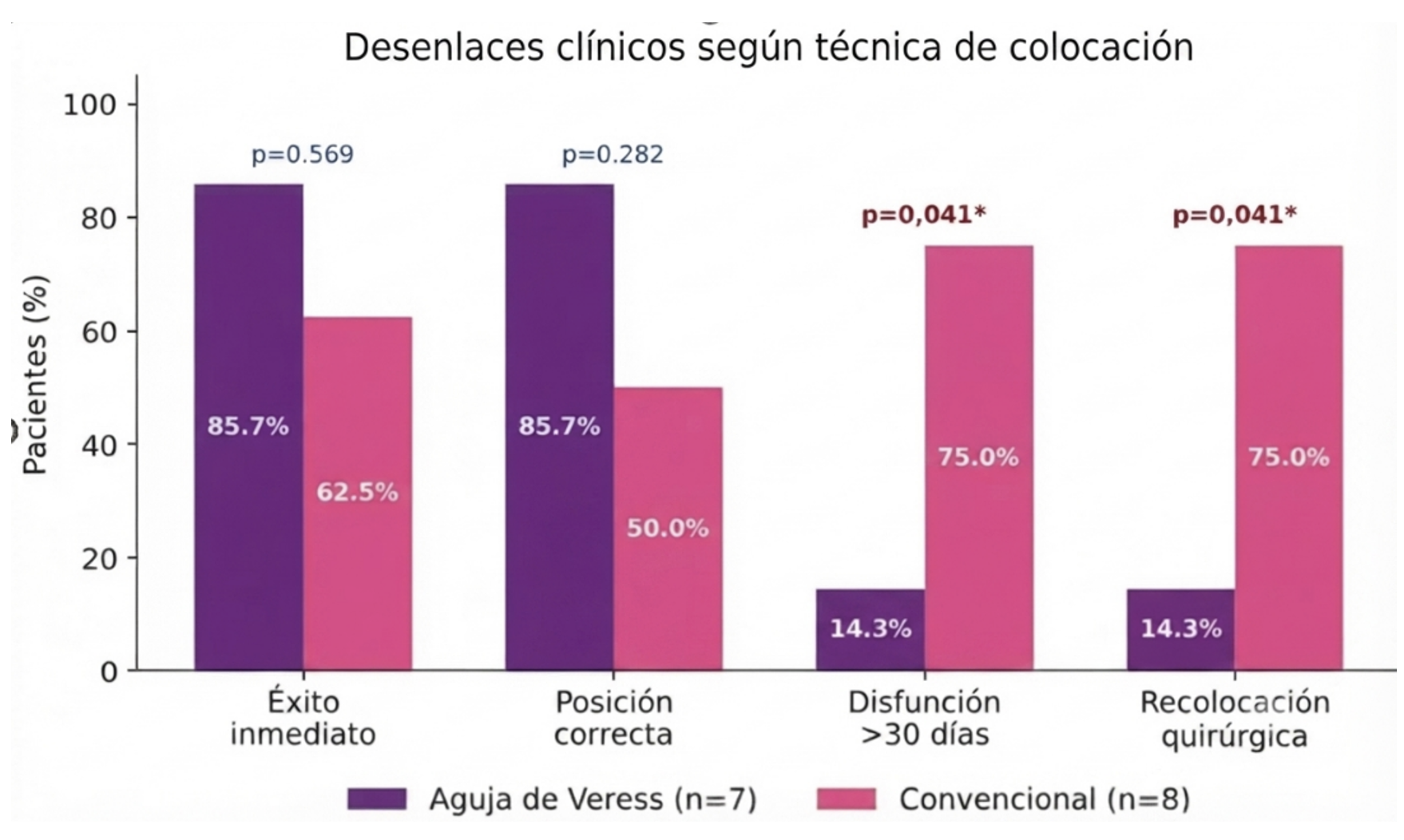
Results: The groups were comparable regarding age, body mass index, sex, and comorbidities. No significant differences were observed regarding immediate functional success, correct catheter positioning, or bleeding. No instances of peritoneal leakage or bowel perforation were recorded. The Veress needle technique was associated with lower rates of catheter dysfunction at 30 days (14.3% vs. 75.0%; p = 0.041) and a reduced need for surgical repositioning (14.3% vs. 75.0%; p = 0.041).
Conclusions: The percutaneous Veress needle technique proved feasible and safe, associating with lower rates of catheter dysfunction and surgical repositioning at 30 days without increasing complications. Prospective studies with larger sample sizes are needed to confirm these findings.
Downloads
Published
Issue
Section
License
Copyright (c) 2026 Adela Anguisaca Vega, Cristina Chediak Terán, Darwin Larcos, Meri Orna, Mayra Oñate, Belén Larco. (Author)

This work is licensed under a Creative Commons Attribution-NonCommercial-ShareAlike 4.0 International License.
 10.56867